

Smart manufacturing market seen topping $841 billion by 2030
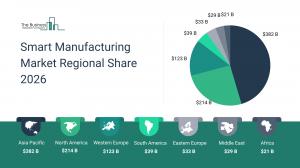
The Business Research Company says the global smart manufacturing market is on track to exceed $841 billion by 2030, with Asia-Pacific and China leading growth. Software is expected to remain the biggest segment as factories invest more in automation, analytics and connected production.
Why it matters: - Smart manufacturing is becoming a core part of the industrial technology stack as factories adopt automation, industrial IoT, AI analytics and digital production systems. - The market’s projected scale points to sustained demand across software, hardware and services, with implications for manufacturers, suppliers and technology vendors. - Asia-Pacific’s rapid expansion and China’s size make regional manufacturing strategy increasingly important for global competitors.
What happened: - The Business Research Company released its Smart Manufacturing Global Market Report 2026, covering market size, growth trends, segments and key competitors through 2035. - The report projects the smart manufacturing market will exceed $841 billion by 2030. - The market is expected to grow at a 13% compound annual growth rate through 2030. - Asia-Pacific is projected to be the largest regional market in 2030 at $382 billion, up from $182 billion in 2025. - China is forecast to be the largest national market in 2030 at $196 billion, rising from $91 billion in 2025.
The details: - Smart manufacturing is projected to represent about 23% of the broader smart technology market in 2030 and close to 6% of the overall information technology industry. - Software is expected to be the largest component segment in 2030 at $499 billion, or 59% of the market. - The market’s technology base includes manufacturing execution systems, programmable logic controllers, enterprise resource planning, supervisory control and data acquisition, discrete control systems, machine vision and 3D printing. - Key end users include automotive, aerospace and defense, chemicals and materials, healthcare, industrial equipment, electronics, food and agriculture, and oil and gas. - Combined hardware, software and services opportunities are expected to generate more than $384 billion by 2030. - Over the five years to 2030, hardware is expected to add $61 billion, software $279 billion and services $44 billion. - Siemens AG led global smart manufacturing sales in 2025 with a 5% market share. - ABB Ltd. held 3%, SAP SE held 2%, Honeywell International Inc. held 2%, Rockwell Automation held 1%, and General Electric Company held 0.5%. - Emerson Electric, Fanuc Corporation, Hitachi Ltd. and Omron Corporation held 0.3%, 0.3%, 0.3% and 0.2% respectively. - The top 10 companies accounted for about 15% of total revenue in 2025, indicating a moderately fragmented market. - Hitachi Ltd. opened an AI center of excellence in March 2025 focused on integrating AI across industrial systems, robotics, sensors and automation.
Between the lines: - The report points to a market shaped by heavy integration requirements, cybersecurity needs and interoperability standards, which can slow consolidation and keep competition broad. - Growth is being supported by Industry 4.0 investment, predictive maintenance demand and government incentives for digital manufacturing. - The strongest use cases are practical ones: reducing downtime, improving asset use, increasing safety and improving real-time visibility on the factory floor. - Software leadership suggests manufacturers are prioritizing platforms that connect production data, planning systems and analytics rather than only buying physical equipment.
What's next: - The report expects continued adoption of connected factory systems, industrial IoT platforms, AI-driven analytics and automated manufacturing tools. - Competition is likely to intensify as vendors expand smart factory ecosystems and deepen partnerships across automation and digital manufacturing. - Manufacturers in electronics, automotive and other capital-intensive industries are likely to remain early adopters because of the payoff from predictive maintenance and process optimization. - The Business Research Company says its 2026 reports include market attractiveness scoring, TAM analysis, company scoring matrices, forecasting dashboards and trend analysis.
The bottom line: - Smart manufacturing is moving from a niche industrial upgrade to a large-scale technology market led by software, automation and AI-enabled factory operations.
Disclaimer: This article was produced by AGP Wire with the assistance of artificial intelligence based on original source content and has been refined to improve clarity, structure, and readability. This content is provided on an “as is” basis. While care has been taken in its preparation, it may contain inaccuracies or omissions, and readers should consult the original source and independently verify key information where appropriate. This content is for informational purposes only and does not constitute legal, financial, investment, or other professional advice.
Sign up for:
Global Agriculture Review
The daily local news briefing you can trust. Every day. Subscribe now.
Check Your Email!
We sent a one-time activation link to: .
Confirm it's you by clicking the email link.
If the email is not in your inbox, check spam or try again.
Welcome back!
is already signed up. Check your inbox for updates.